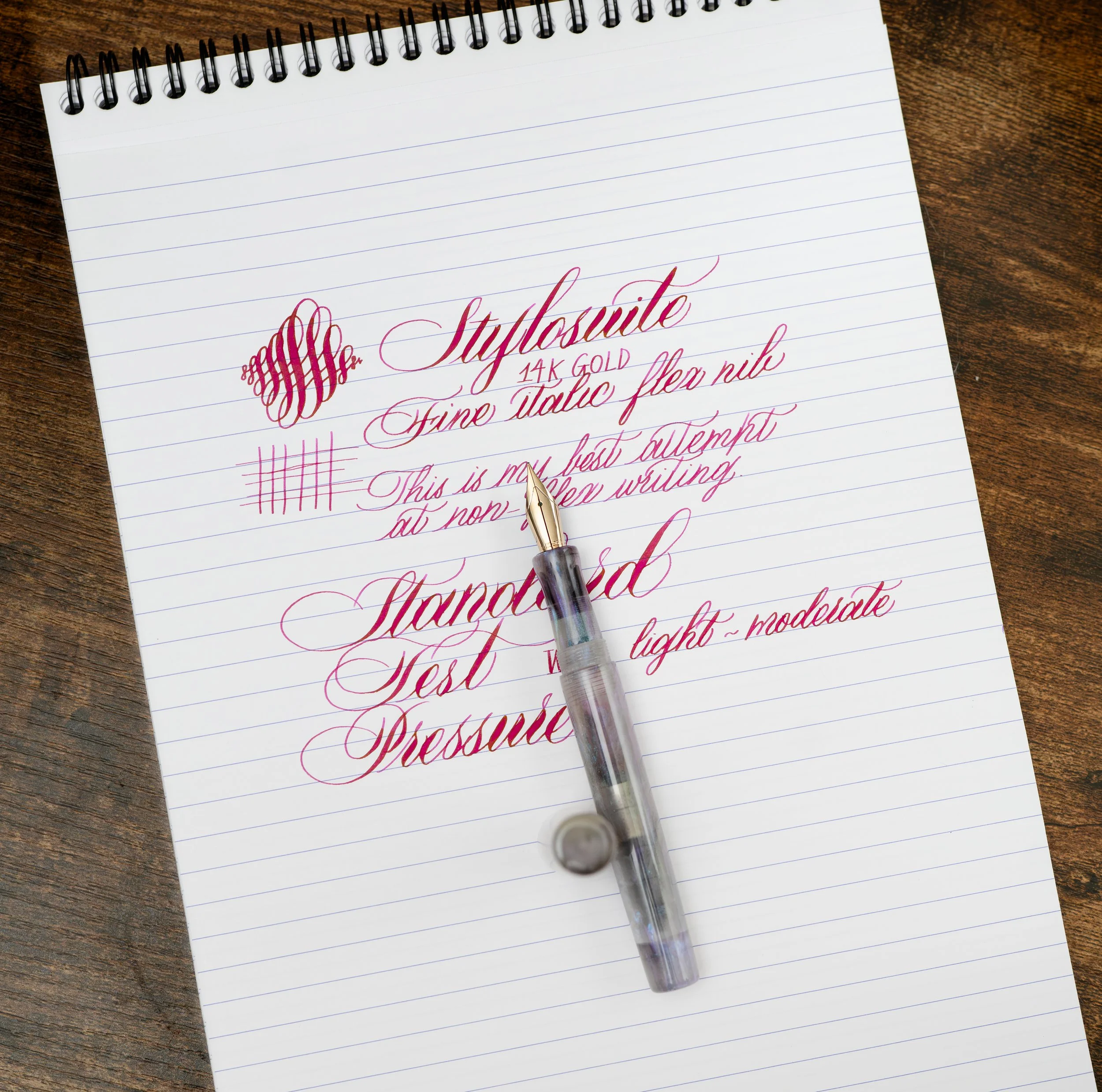
My Greatest Find at the DC Pen Show — The StyloSuite 14K Gold Fine Italic Flex Nib
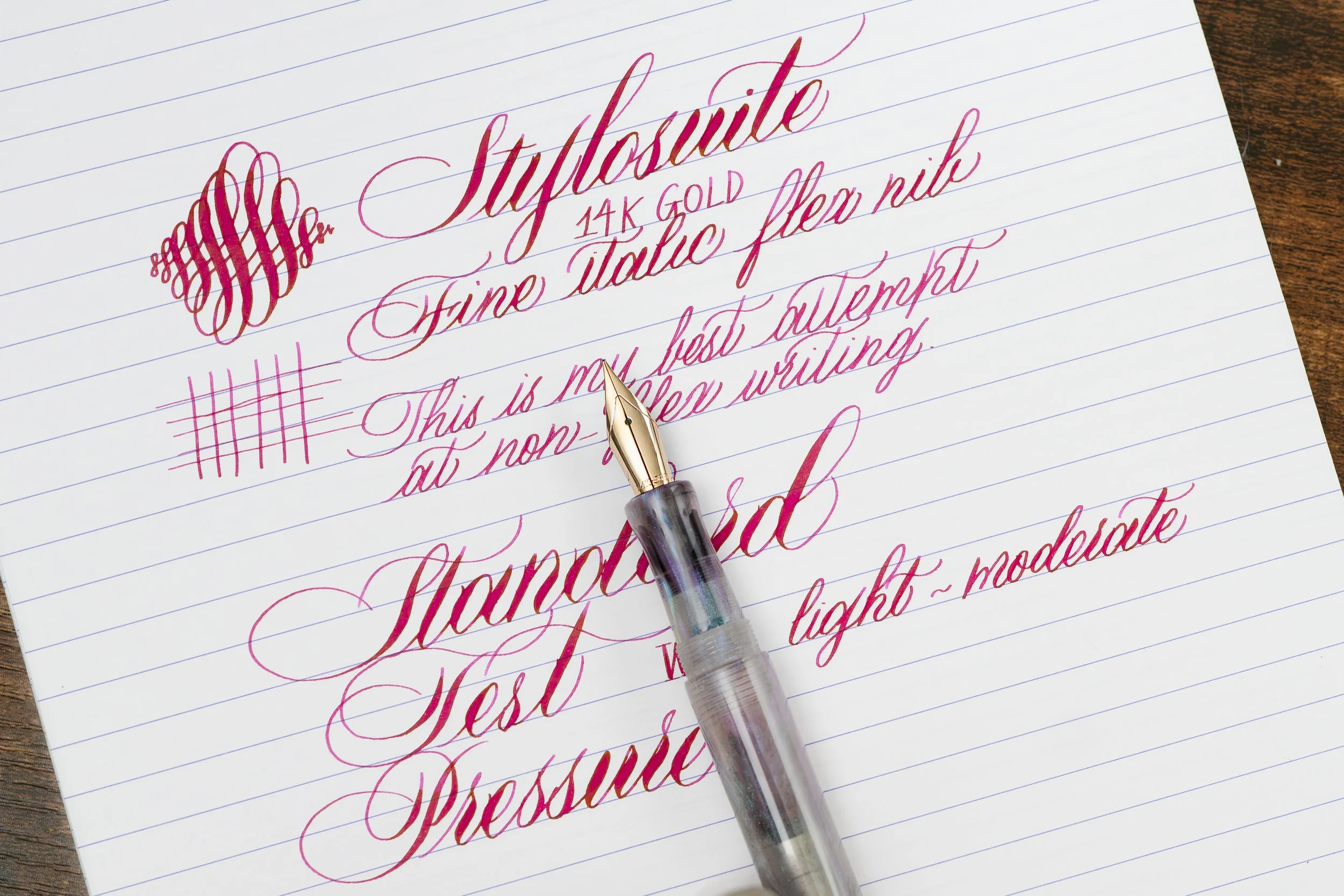
I haven’t been this excited about a flex nib in a long time, especially a modern flex nib.
As my flex nib collection has grown, I’ve become much pickier about buying new ones. A nib needs to offer something distinctive before I’m willing to add it to my collection. The StyloSuite 14K Gold Fine Italic Flex was one of those rare nibs that made me pull out my credit card without blinking.
But I want to be clear: I love this nib not because I think it is the perfect flex nib for everyone. I love it because it fits the way I personally use flex nibs. I write with a very light hand, want obvious line variation without applying much pressure, and value smoothness and comfort more than the finest possible hairlines at my current state of collection.
The most interesting part of the story, this nib wasn’t what I went looking for initially.
The StyloSuite Personalization Experience
With StyloSuite, you aren’t simply buying a pen or nib. The experience of finding the right nib is an important part of the purchase.
You sit down at Les’s table expecting to try and buy a particular nib, only to leave with something you might have never considered. That is the magic of the StyloSuite table.
You begin with a general idea of what you want and try a few pens that seem to match. Based on your feedback, Les brings out other options for you to test. You may repeat this process several times depending on how stiff, how soft, how smooth, how fine, how much flexibility you desire in this process.
Eventually, you find the nib that feels right in your hand.
This kind of personalized fitting matters because specifications can only tell you so much. The nib that suits your writing habits may not be the one that matches your original shopping list. That was certainly true for me.
I sat down in the magic chair expecting to buy an EEF or EF flex nib. Because I have a very light hand, I assumed I needed a very fine and extremely soft nib to produce the kind of line variation I enjoy.
Then I started trying the italic flex nibs, and they completely changed my mind.
Why an Italic Flex Nib Works for Me
Regular cursive italic, italic, and stub nibs produce broad downstrokes and thinner horizontal strokes. Although I enjoy that effect, it isn’t necessarily the type of line variation I use most often.
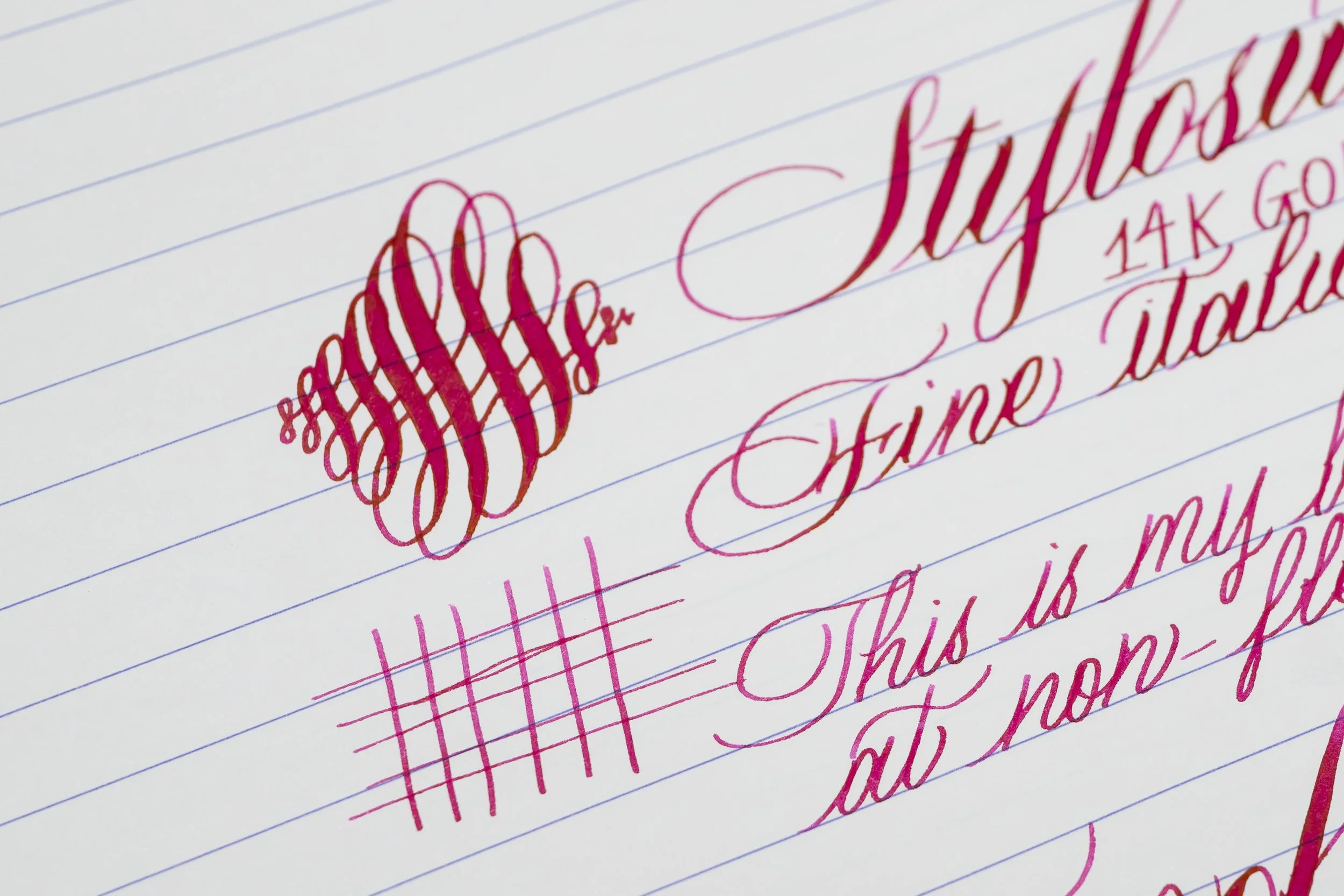
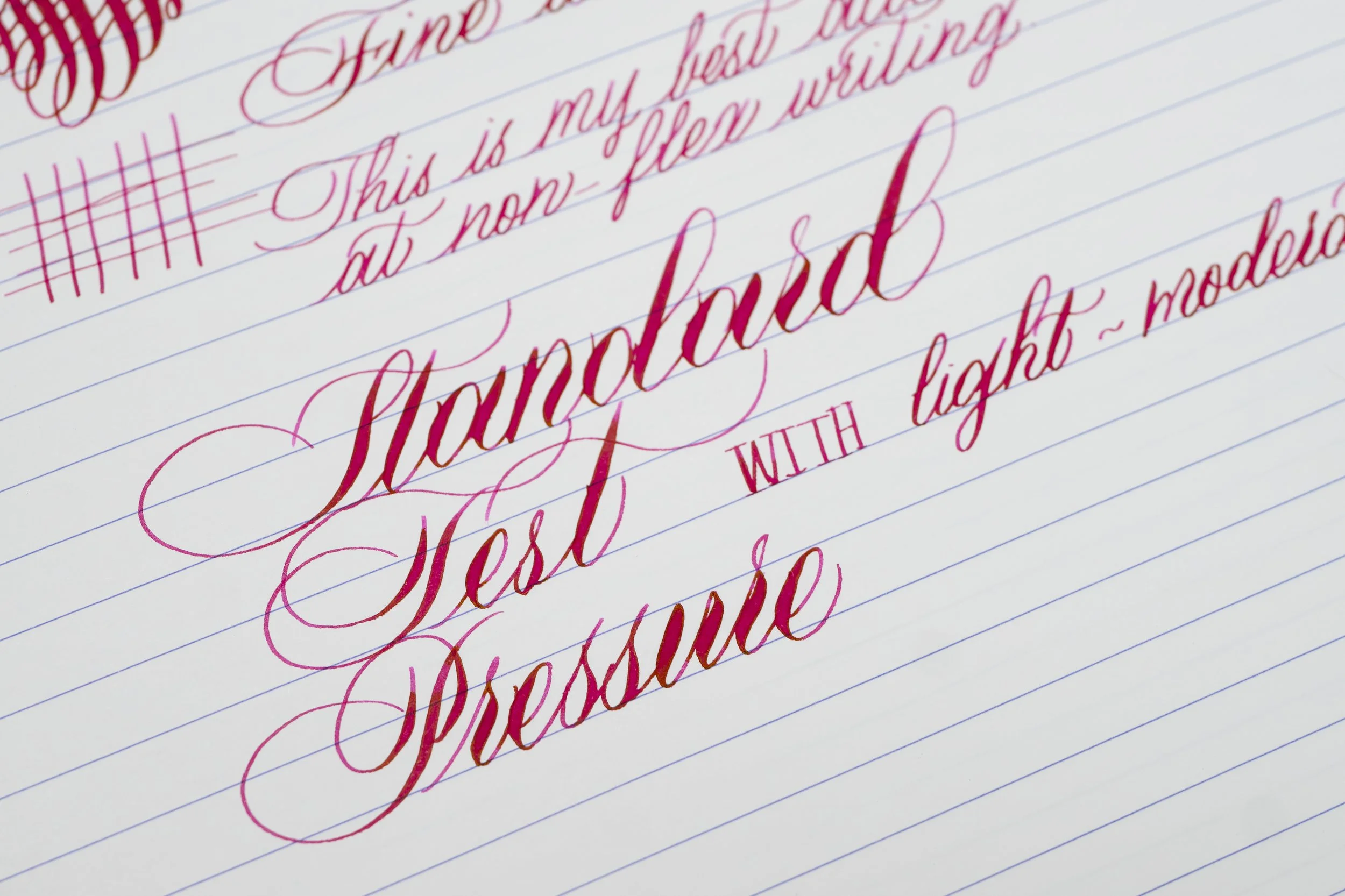
A flexible italic nib is different. It combines the natural line variation of an italic grind with the additional variation created when the tines spread. This makes it possible to produce broad, shaded strokes without applying much pressure.
The simplest way to describe it is:
Maximum total line width = tipping width + flex
With a conventional italic nib, the maximum downstroke width is determined mainly by the size of the tipping. A flexible italic nib isn’t limited in the same way. Its maximum width comes from both the italic tipping and the amount of tine spread, allowing it to produce a much broader line.
That is especially useful for someone with my writing habits.
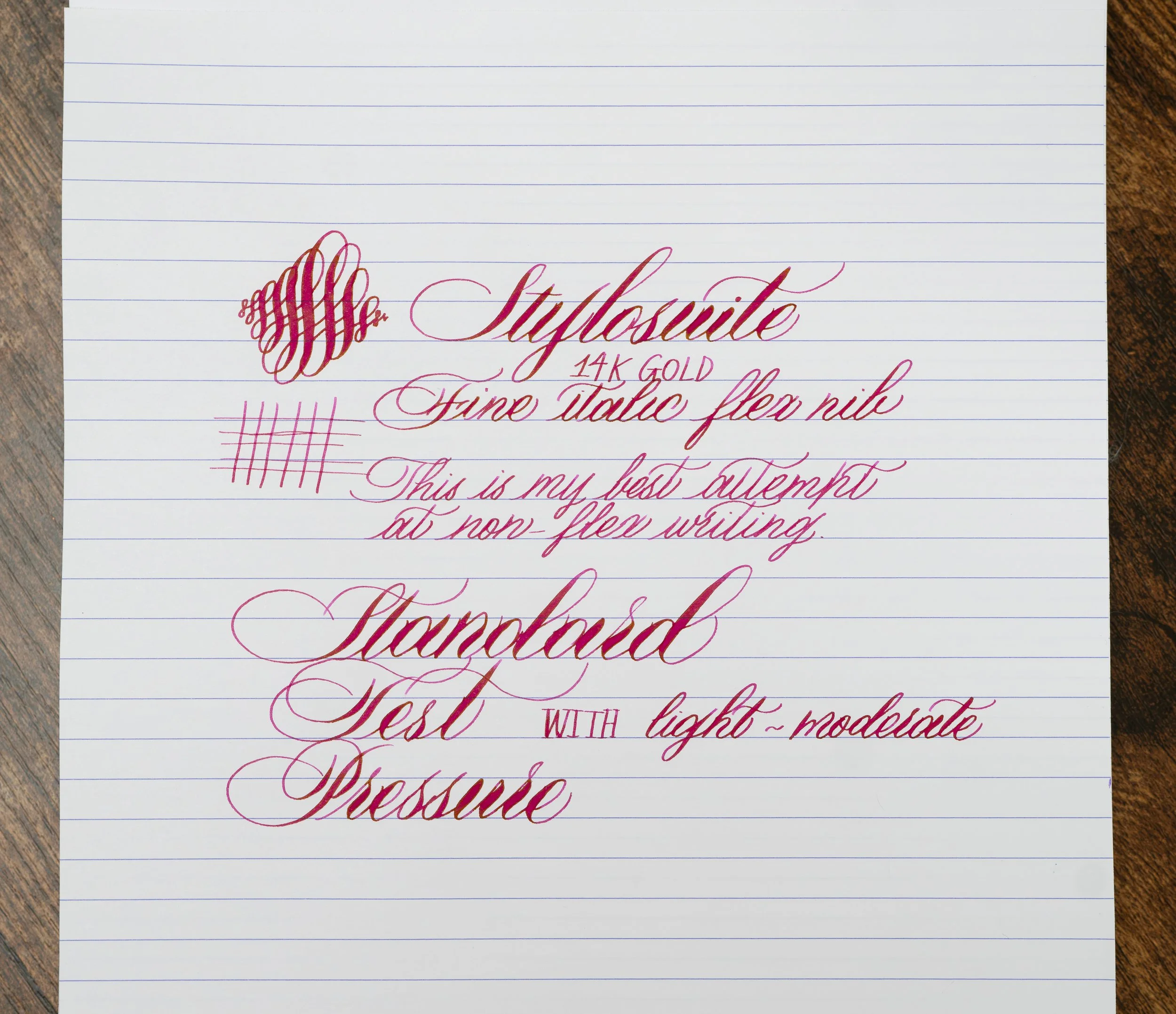
Because the Fine Italic Flex starts with a wider line than an EF or EEF flex nib, I don’t need to press as hard to reach the 1.2–1.5 mm line widths I commonly use. I can achieve satisfying variation with less pressure, which means less strain on my hand.
For me, that ease and comfort are major advantages.
But What About the Hairlines?
The tradeoff is that the Fine Italic Flex naturally produces thicker hairlines than an EEF or XXF flex nib. I’m completely comfortable with that.
I don’t need every flex nib in my collection to be XXF. In this case, accepting slightly thicker hairlines in exchange for extreme smoothness and low-effort flex feels like a very fair trade.
It is also possible to create thinner upstrokes with a little technique. I can use the corner of the italic nib to pick up the ink left behind by the preceding downstroke, then guide that ink through the upstroke. Because I am using only one tine to guide the ink and not pressing down on that tine, the risk of pushing the tines out of alignment is minimal.
The result is an easy, soft italic flex with generous spread while still allowing reasonably thin upstrokes when I want them.
Choosing the 14K Gold Version
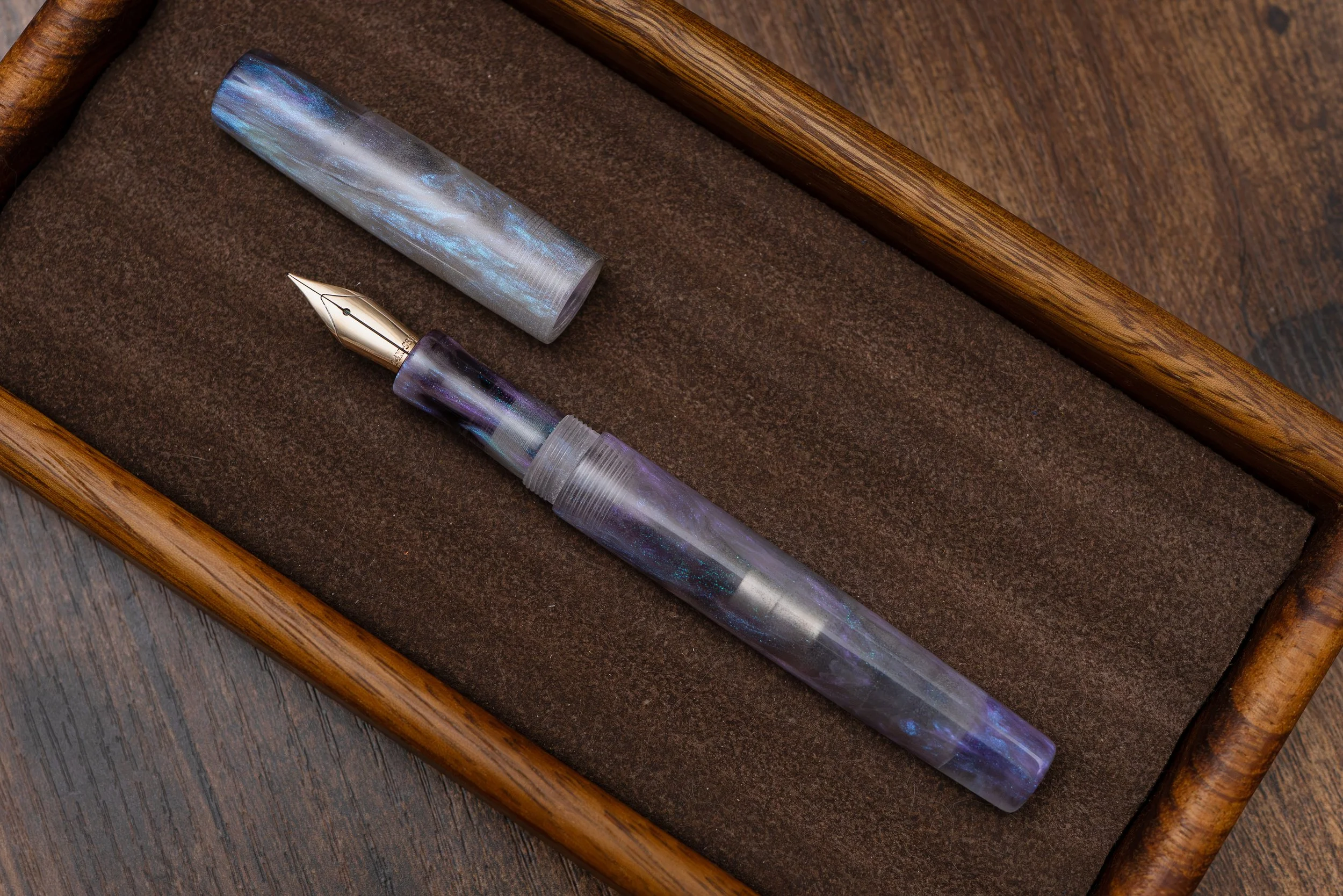
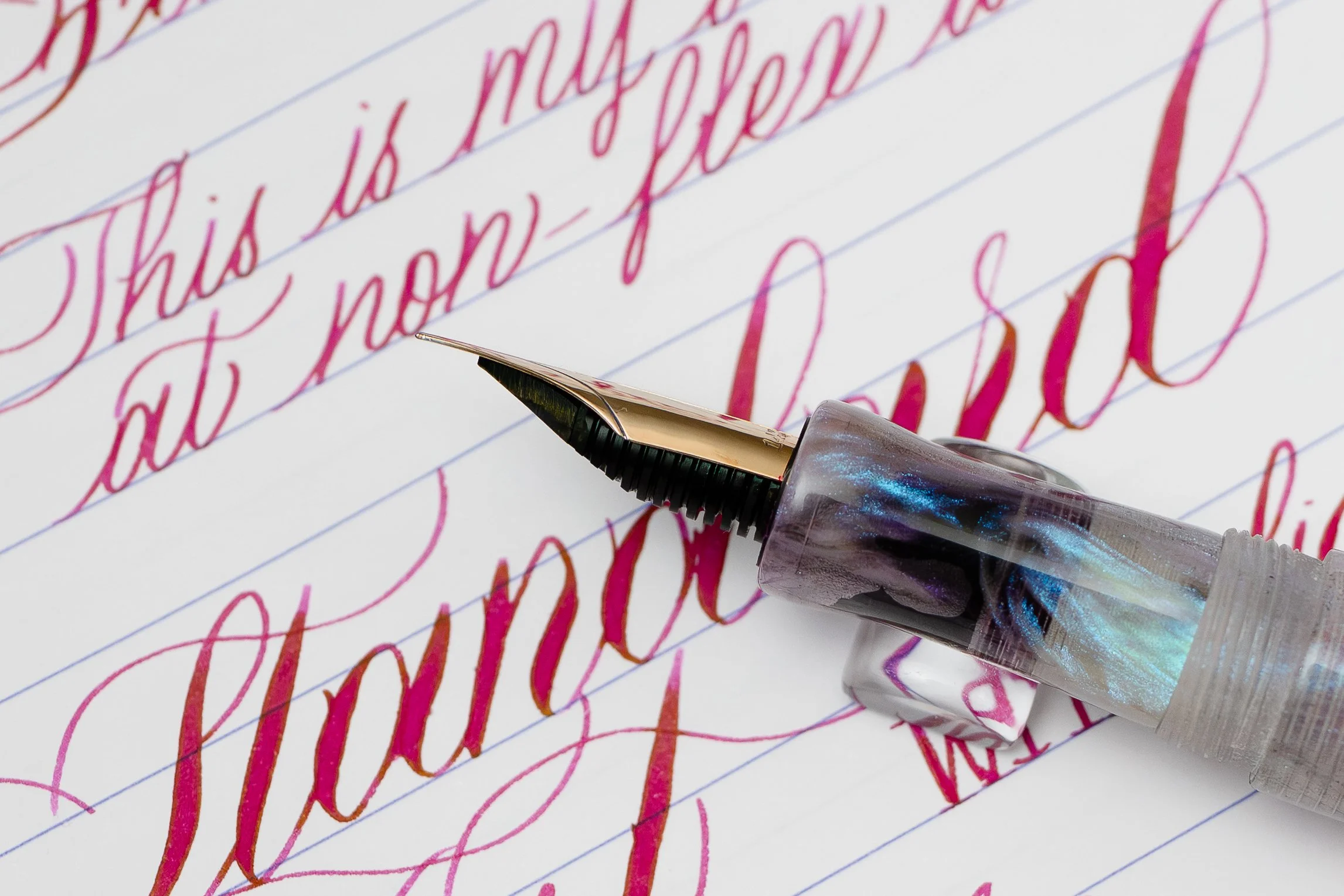
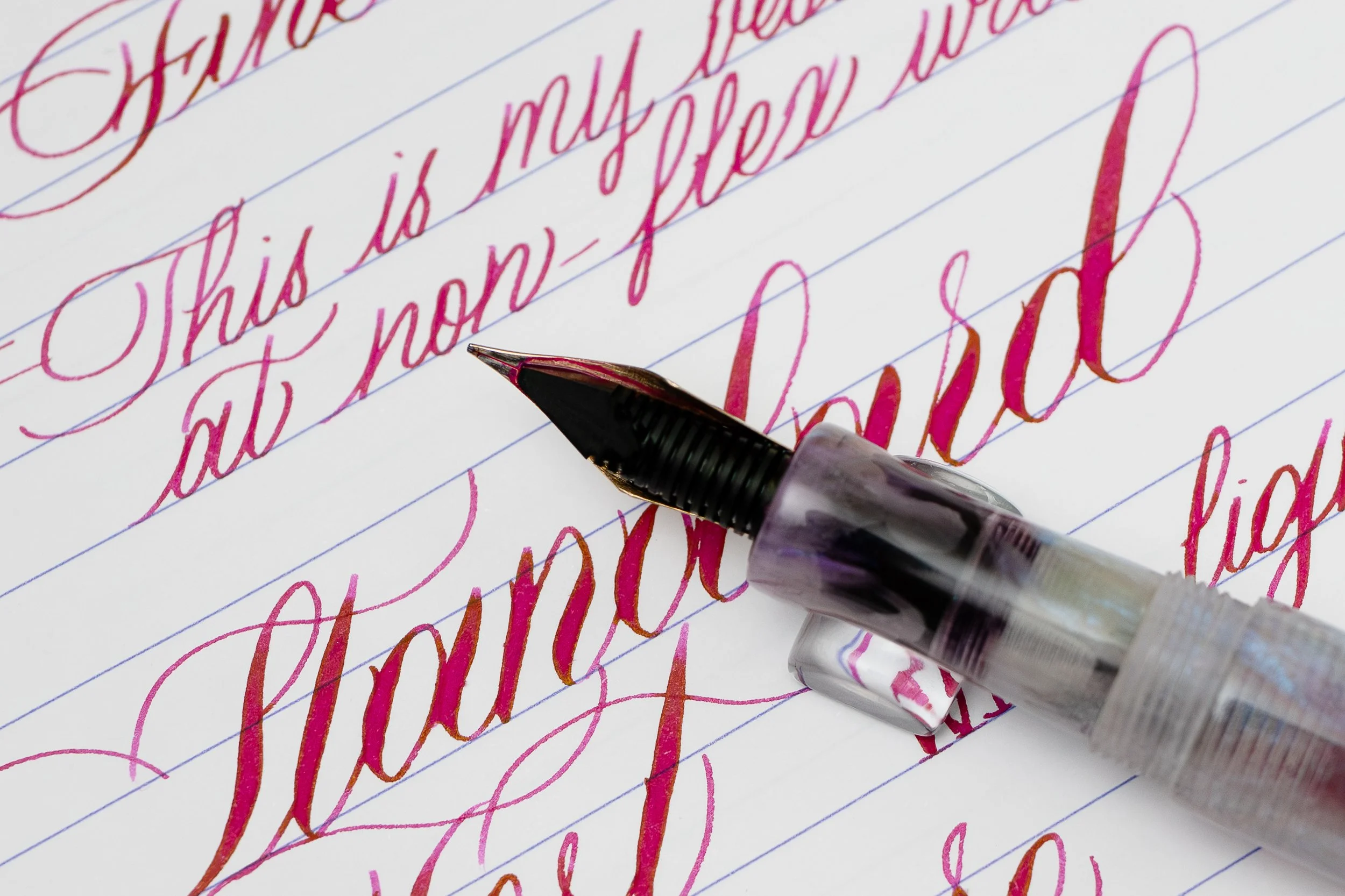
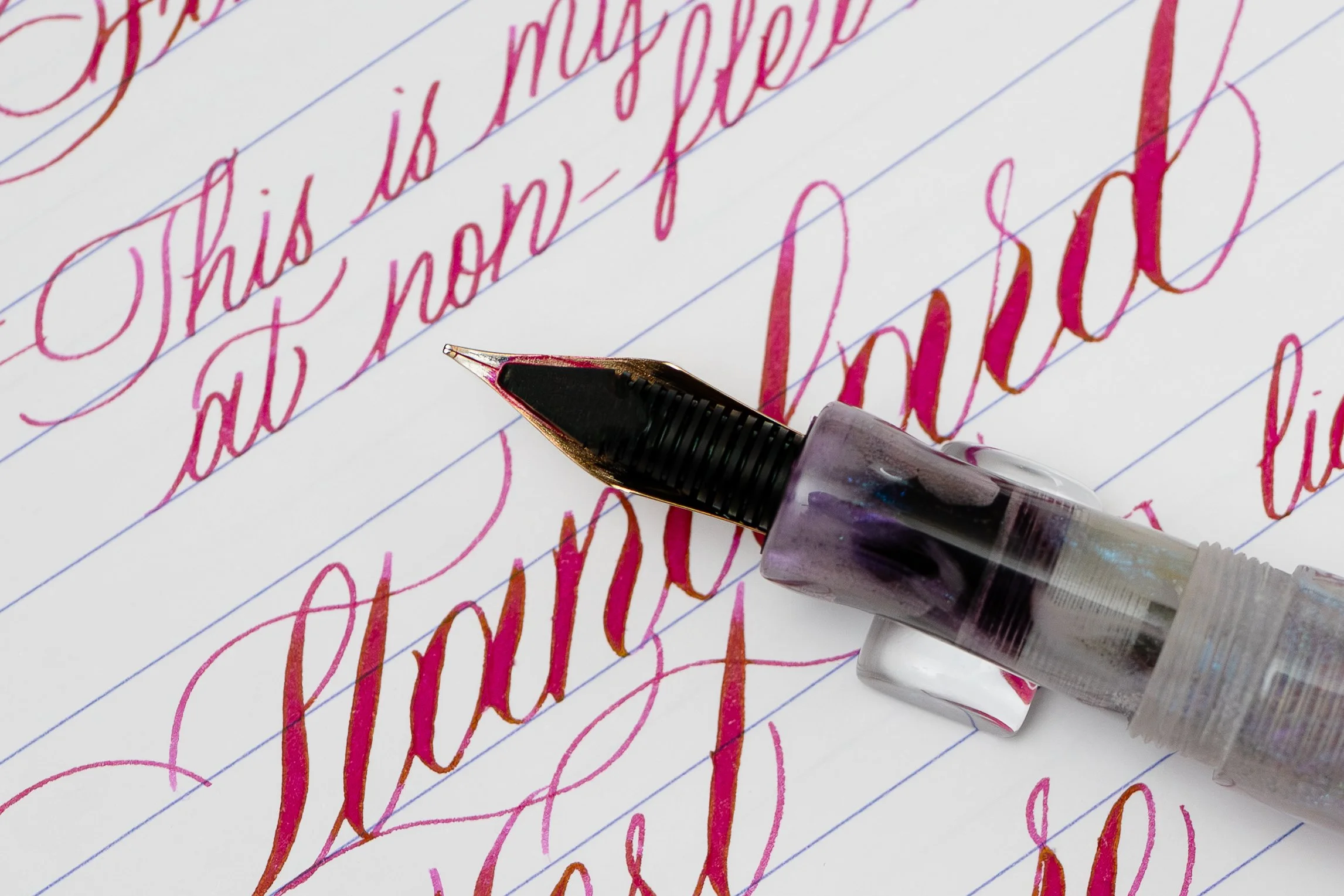
The nib I eventually chose was the StyloSuite 14K Gold Fine Italic Flex.
At first, I was already very happy with the steel Fine Italic Flex nib. Les still encouraged me to try the 14K gold version, and that nib immediately won my heart.
It has everything I personally look for in a flex nib. It is extremely smooth and soft, requires very little pressure to produce obvious line variation, and has fast snapback. Most importantly, it achieves a wonderful balance: it feels soft under my light hand but still recovers quickly enough to keep the letterforms controlled.
The nib reminds me of a vintage flex nib from around the 1920s, but for my preferences, it feels even better. It offers some of the softness and responsiveness that I love about vintage flex while being larger than many vintage nibs and housed in a convenient modern format.
It is fitted in a JoWo #6 nib unit, so I can use it in different JoWo-compatible pen bodies. That flexibility makes the nib even more practical for my collection.
A word of caution: nib swapping should only be attempted by someone with the necessary experience. If you aren’t comfortable handling and aligning nibs, ask Les for help rather than risk damaging such a carefully tuned nib.
Writing Characteristics and Measurements
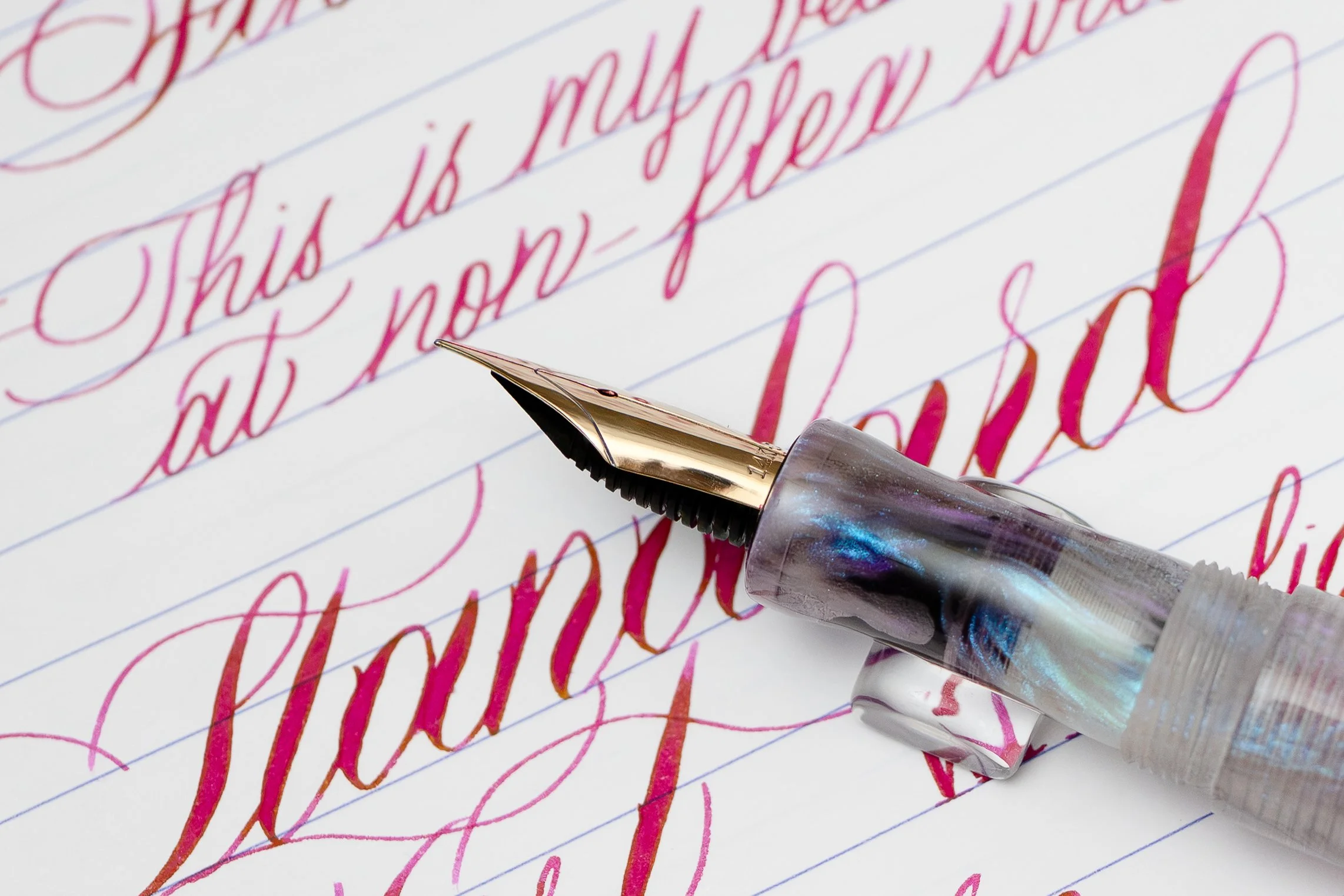
The exact measurements can vary depending on the ink, paper, writing angle, and amount of pressure used, but these are my approximate observations:
The Fine Italic tipping writes more like a medium, at approximately 0.7-0.8mm, depending on the ink and paper combination.
Its horizontal stroke is about 0.3 - 0.4 mm, roughly comparable to a Western EF.
The italic part is not what I focus on writing. I like the smoothness but since the nib is more rounded on the edges, it writes more like a cursive smooth italic than a crispy sharp italic.
The flex adds approximately 1.2~1.4 mm of width.
The nib can reach a total line width of around 2~2.2mm.
Ink flow is very generous as it is fine-tuned with ebonite feed by Les, even when using a cartridge/converter.
I haven’t experienced railroading during my regular use.
That last point is important. A flexy nib isn’t very useful if the feed can’t keep up with it, but this one remains juicy and reliable while flexing.
A Nib That Fits Me
I wouldn’t describe the StyloSuite 14K Gold Fine Italic Flex as the ideal nib for every flex writer.
Someone who prioritizes needlepoint hairlines may prefer an EEF or XXF flex nib. A writer with a heavier hand may want a firmer nib, while someone who enjoys very crisp italic feedback may prefer a different non-flex grind. Personal writing angle, pressure, speed, and preferred scripts can all affect which nib feels best.
My enthusiasm comes from a particular combination of preferences. I have a very light hand, enjoy generous line variation, and want to achieve that variation without sustained pressure. I also value an extremely smooth writing experience and am happy to accept slightly thicker hairlines in return.
For those reasons, this nib suits me remarkably well.
More importantly, I probably would not have chosen it from a specification sheet or based on reviews from others. I found it by sitting down, trying different nibs, describing what I felt, and allowing the testing process to lead me away from what I thought I wanted.
That personalized experience is what made this discovery so memorable. I didn’t simply find an excellent nib at the DC Pen Show. I found a nib that feels as though it was chosen specifically for my hand.
Behind this experience is Les, the kind and patient nibmeister behind StyloSuite. It was a genuine pleasure to meet him. Throughout the testing process, he listened carefully to my feedback and never made me feel rushed, even as I worked through different combinations of fineness, softness, smoothness, and flexibility. His patience and thoughtful recommendations made the entire process feel smooth, relaxed, and genuinely enjoyable.
I would highly recommend sitting at Les’s table whether you are just beginning your flex-nib fountain pen journey or are already a seasoned collector. Beginners can benefit from his guidance as they discover what different flex characteristics feel like, while experienced users may be surprised, as I was, by a nib they might never have selected from its specifications alone. The goal of exploring fountain pens isn’t to find a nib that is universally “the best,” but to find one personalized to your hand, writing habits, and preferences.