How to Use a Flex-Nib Fountain Pen Without Breaking It: 3 Common Mistakes Beginners Make
I have wanted to write this post for a long time. Flex-nib fountain pens are a beautiful but also a very niche part of the fountain pen world. I think anyone interested in trying one should understand the common habits that can damage a flex nib.
Most people have heard the basic warning: do not press too hard, or you may spring the nib. A sprung nib usually refers to a nib that has been pushed beyond its elastic limit. Instead of returning cleanly to its original shape after flexing, the tines may remain spread, misaligned, scratchy, or unable to write properly. For flex-nib fountain pens, springing is often caused by excessive pressure, but pressure direction and writing angle matter just as much.
These small technical details are not always discussed when people troubleshoot flex-nib problems. With more affordable flex-nib options becoming available, more beginners are trying flex writing for the first time. That makes it even more important to understand what can go wrong before damaging a nib.
Here are three common mistakes new flex-nib users should avoid.
Mistake 1: Chasing Maximum Flex Immediately
One of the easiest ways to damage a flex nib is to receive a new pen and immediately try to push it to its maximum line width.
When you first get a flex-nib fountain pen, the first step should be learning the nib’s range gradually. Start with very light pressure, then slowly increase it while paying close attention to how the nib feels.
For example, if reviews or writing samples suggest that a certain nib can flex up to about 1.5 mm, that does not mean you should immediately try to push your own nib to 1.5 mm. You do not know what ink, paper, writing angle, or hand pressure the reviewer was using. When you are still getting familiar with the nib, it is safer to stay below the maximum range. If a nib is said to flex to 1.5 mm, I would personally avoid going beyond about 1.2–1.3 mm while learning it.
That small buffer can help protect your nib.
As you slowly increase pressure, you may eventually feel a point where the nib begins to resist further flexing. You are pressing harder, but the line width is no longer increasing much. That is usually a sign that you are approaching the nib’s practical limit.
This is something you can only learn by using the nib carefully and gradually. So when you receive a new flex-nib fountain pen, do not rush into dramatic flexing right away. Learn the nib first.
Mistake 2: Twisting or slanting the nib while flexing
Another common mistake is treating a flex-nib fountain pen like a pointed dip pen.
This often happens when beginners are attracted to flex nibs because they want to practice calligraphy with a fountain pen. They usually bring the habit of using a pointed dip pen with them when they first transition to a flex-nib fountain pen. With a pointed dip pen, the right tine of the dip nib is tilted at an angle to create dramatic shaded strokes. But a flex-nib fountain pen is not the same tool.
When using a flex-nib fountain pen, both tines need to receive pressure evenly. If you slant the nib while pressing down, one tine takes more pressure than the other. This can easily lead to tine misalignment, scratchiness, and in worse cases, permanent nib damage.
The softer the flex nib, the more vulnerable it may be to this kind of uneven pressure.
The safer approach is to keep the nib aligned with the direction of the stroke. The two tines should open evenly when flexing, and the nib should stay balanced against the paper.
If you want to write slanted letters or shaded strokes, rotate the paper instead of twisting the pen. Practice vertical shaded strokes first, with the downstroke moving straight away from your body at an approximate 90-degree angle. Once you understand how the nib opens and recovers, you can adjust the paper angle and your body position while still keeping the flexing motion controlled and even.
In simple terms: do not force the nib to flex sideways. Let the tines open evenly.
Mistake 3: Heavy Flexing at a Steep Writing Angle
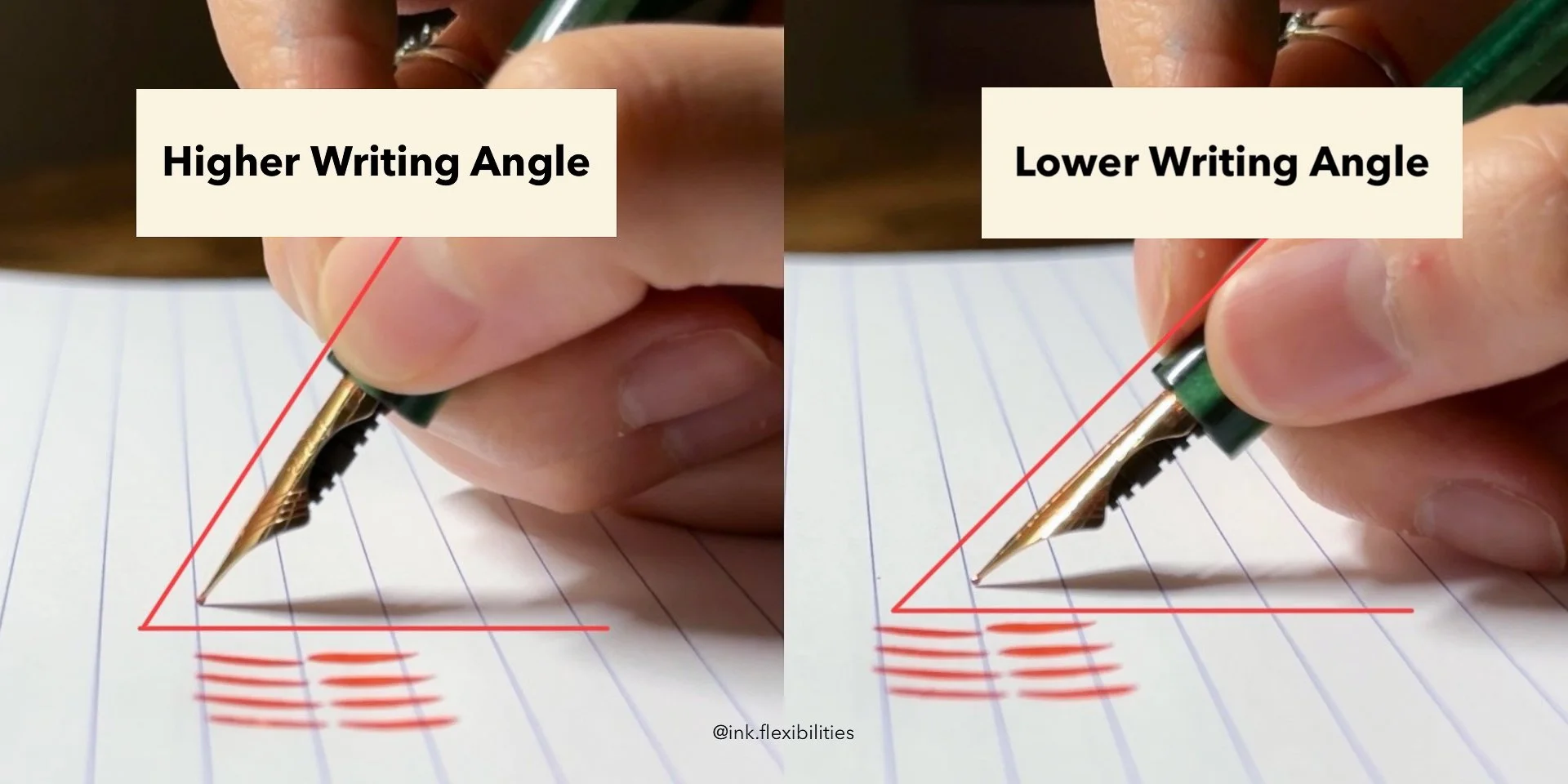
The third mistake is flexing heavily while holding the pen at a steep writing angle.
By “writing angle,” I mean the angle between the nib and the paper. A higher or steeper writing angle means the pen is more upright. A lower writing angle means the pen is held closer to the paper.
When you press hard at a steep angle, the pressure is concentrated near the very front of the nib. This can make the nib more vulnerable to bending, cracking, or even breaking, ESPECIALLY when attempting wider flex.
If you want to create broader flex strokes, lowering your writing angle can help distribute pressure more evenly across the nib. This usually reduces the amount of force needed to open the tines and makes the flexing motion safer for the nib.
This is one reason why two people can use the same flex nib pen but get different results. One person may be able to achieve wider line variation safely because their writing angle allows the nib to flex more naturally. Another person may damage the same nib by applying similar pressure at a steeper angle.
The larger the flex, the more important your writing angle becomes. Heavy pressure plus a steep angle is one of the riskiest combinations for a flex nib.
Final Note: Have Realistic Expectations Before Buying a Flex Nib
This is not exactly a “mistake” in the same way as the three points mentioned above, but I think every beginner should understand it before buying a flex-nib fountain pen.
The entry barrier for flex nibs is higher than for most stationery products. It is not only about price. It is also about technique.
A gel pen usually writes as soon as you uncap it. A regular stiff-nib fountain pen is also relatively forgiving as long as it is inked properly and held at a reasonable angle. A flex-nib fountain pen is different. It asks more from the user.
To use a flex nib well, you need to understand ink flow. You need to learn how to apply pressure correctly. Most importantly, you need to know where the nib’s limit is, and when to stop.
For beginners, that last skill is often the hardest. Many people become interested in flex nibs after watching videos of dramatic line variation, so it is easy to develop unrealistic expectations. But not every flex nib is designed for extreme line width, and even a capable flex nib still needs to be handled with control.
A flex nib can be challenging to use because it requires sensitivity. You need to feel how the nib responds, recognize resistance, and respect its limits.
For many beginners, tine misalignment or an over-flexed nib becomes their first “tuition fee” they pay when entering the flex-nib world. I hope this post can help new flex-nib users avoid that experience, protect their nibs, and enjoy flex writing with more confidence.
⬇Side note⬇
If you are choosing your first flex nib, you may also find my modern flex nib comparison table helpful, where I compare softness, snapback, smoothness, ink flow, and maximum flex across different modern flex nibs.